
Discipline and Respect. Or Connection and Clarity?
Sep 23, 2026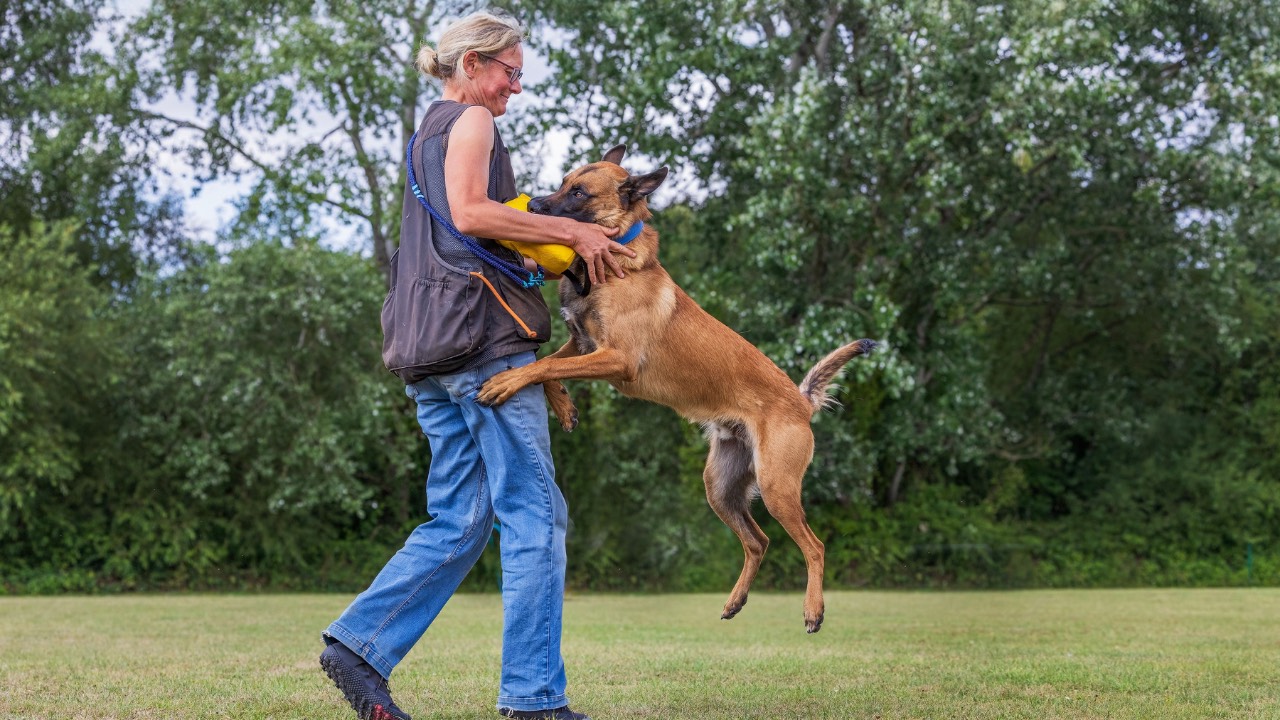
I'm increasingly feeling uncomfortable with the word 'obedience.'
Which feels strange to say. I've loved the sport of competitive obedience. I've made up two home-bred Aussie obedience champions. In IGP, the obedience phase is one of my favourite things to train. So it feels a bit weird that somehow the 'obedience' I love so much is just starting to give me the ick.
It has done so for a long while now, but my thoughts were really solidified after some thinking I was doing to prepare for a live training to help a Mindset Mastery member. She'd been told her dog needed more 'respect' for her. That she needed more 'discipline.' And she's not unusual. I hear this all the time. In obedience circles, in IGP circles. It's the kind of thing that those I used to train with would have said without a second thought. That I need more authority. I'm weak. My dogs need to respect me. These are things I've heard hundreds of times.
So I'm definitely not shaming one person in particular. What I'm doing is getting curious. Curious about the mindset behind dog training. About the way we train our dogs, the way we perceive them, and the extraordinary things they do with us every single day.
But now I think of things differently. I now think that the words Discipline and respect sit inside a particular mindset. One that's about power. About hierarchy. About doing something because I said so. And that top-down approach to power has a very long history. It's the same paradigm that has been used throughout history to create obedience in slaves, in animals, in women and children. It's old. And it's tired. I'm done with it. The top-down power dynamic feels to me like it's coming to an end. And I think that's a good thing.
Now, I want to be clear about where the lines are for me, because this is nuanced. In everyday life, yes, there are non-negotiables. I don't want my dog running into traffic, chasing sheep, ignoring a recall. There are rules, there are boundaries, and they need to follow them for all of our safety. I understand that completely. And my dogs do too. There are some hard and fast rules and boundaries.
But for flashy heelwork? A beautiful retrieve? A fast, joyful finish? A quick down? For a quick out in protection?
Do it because I said so?
No. That's just not fun to me. Not even a little bit.
I want a dog who does it because they really want to. Because of all the things in the world, they'd choose to play with me. Because they value our relationship. Because the things I'm asking them to do actually feel good to them. I want it to feel like ha, that's a cool idea! I like this challenge. This is fun! That energy of genuine enthusiasm and willingness is, to me, the whole point. It's what I'm chasing. Not compliance. Not a dog that performs because the alternative is unpleasant. Not a dog who does something to avoid the consequences of not doing so.
And if they don't want to connect? If they don't think it's fun? That's on me. Full stop.
And if they make a mistake? If they don't do something properly? It's not because they need discipline. It's because I haven't taught them clearly enough. So I go back to the drawing board. I get creative. I think, how can I make this clearer? How can I explain this differently?
I do the same thing with the humans I work with. If someone in my team doesn't understand what I'm saying, I don't tell them off for it. I just ask them to explain back what they heard, or I try saying it a different way. And it usually works. Dogs are no different. I might explain something in a variety of ways, in different contexts, so that it becomes easy for them to piece together what we're actually up to. The understanding builds gradually, joyfully, through repetition and variety and connection. Not through correction.
It was interesting when a helper who was new to me met Rumi and I this weekend and he asked how I did it. I'm not really sure what he meant, because like you, I just do what I do. But I think he was wondering how this huge, powerful and very charged dog complied with such obvious joy and clarity.
And I do believe that our connection is the answer. And yes, clarity. He really knows what I mean. There's no doubt in his mind. And no conflict at all, he doesn't get any 'corrections' for his work. Which in protection in IGP is pretty unusual.
So these days, I'm far more interested in two things. Connection and clarity.
Connection means it's me and my dog against the world. We have each other's back. We trust each other. We'd do anything for each other. Because that's what love looks like in practice. It's not a feeling you declare once and leave there. It's something you build, quietly, in hundreds of ordinary training sessions. And in the way you hang out on the sofa. It's in the way you show up. The way you make the work feel worth doing. And the way you both just get along together. The way your dog looks at you and feels safe and thinks, yes, this is my person.
And clarity is how I honour that connection in training. I use location-specific markers to help my dogs understand exactly what I'm asking. I use energy, body language, mindset. I pay attention to what my dog is communicating back to me. I try to create a picture that is so clear they can't help but understand it. Because a dog who doesn't know what you want isn't being difficult. They're just waiting for me to explain it properly.
These are the tools that create dogs who thrive. Dogs who perform with joy and with heart. Not dogs that comply out of fear of the consequences.
Because at the end of the day, my 'success' in dog training is my day to day success of my dog living, loving and working with joy, without fear, pain or intimidation. And feeling like anything they do is just fabulous. Which it is, to me! 💛🐾

